Original :
As I grew up,
I had total respect and admiration for love.
I wanted to relish in the love and adoration,
from the crowd.
I totally admire and envy those who can love.
Instead,
I’m the one that followed my old lovers escape.
To be part of the hideout,
I automatically drowned myself in the nearest river,
that cut my way away from loving,
loving anyone.
For the songs are what drowned me out,
by the repeated pleas for Nirvana.
Nirvana haunts even the worst,
the worst of us.
Nirvana is playing on her headphones all night,
she tends to sleep-mumble the lyrics.
If you want to save yourself from drowning,
that's how you do it.
Feelings and appreciation can never be expressed in words.
Sometimes,
you just have to be who you are,
when you play the hits.
And with this,
you can release...
yourself
Translated from English, to Spanish, back to English:
When I grew up ,
I had total respect and admiration for love.
He wanted to savor in love and worship,
from the crowd.
I totally admire and envy those who can love.
Instead,
I am the which followed my old lovers escape .
To be part of the den,
I choked me automatically in the nearest river ,
who cut my way away from love ,
love anyone .
For songs are what choked me ,
by repeated requests from Nirvana.
Nirvana even the worst torments ,
the worst in us .
Nirvana is playing in your headphones all night,
she tends to sleep - murmuring the lyrics.
If you want to save drowning ,
This is how you do it.
Feelings and appreciation you can never put into words.
Sometimes ,
you just have to be who you are to replicate successes .
And this,
It can be released...
yourself

Art & Society Fall 2015
Blog Posts are due by 11:59pm on Monday nights. 250 word minimum.
Showing posts with label Karyn. Show all posts
Showing posts with label Karyn. Show all posts
Monday, November 16, 2015

Wednesday, November 11, 2015

I drew this picture inspired by Max Ernst. I loved his meaning behind his painting and wanted to replicate it because I felt that I related to it’s purpose. The paper rolling down shows what is in the mind above and the actual eyes of, in this case, me, underneath. I chose to draw the phases of the moon, differentiated from the original painting that has circular figures you can't quite make out. These phases of the moon interpret me well, I believe, because to me the phases of the moon are the phases of me and my life. There are times of darkness, with bad occurrences. There are times of brightness, with much positivity. And sometimes in life, there is also good within the bad and bad within the good. Which are the moments when the moon is half dark, half lit. Or even when the moon is mostly lit than dark or more dark than lit. I have been through alot in my life and those who are close to me are very clear on when my moon is shining bright or when my sky is completely filled with darkness. The times of darkness in my life, are just phases. Just as the good times are as well. Nothing in life is permanent and I have come to an acceptance of that. When those who are close to me look at me and what i’m dealing with, I think they almost expect me to be okay. They know I will be okay because with the help of the stars, metaphorically my friends and family, I will move on to the next phase when the time passes. My eyes are big and dark and often pointed out by many. Which is why I love drawing eyes often. To me, my eyes have the moon within them in a way. You can look into someones eyes and almost tell what phase they are going through. My friends and family can easily look into mine and tell if i’m in a moment of darkness or close to it. This depiction has nothing at all to do with stereotypes because nobody expects anything of me when they do not know me. Well, at least they don’t expect all the things I've been through or my mood of the day or year. You can’t look at me and think, oh she has big eyes so she has a curious mind. Or, look at her, she looks like she has been through a lot. Nobody knows. Unless you catch me on one of my days when I decide to dress in all black. Then, a stereotypical person may judge me off of appearance. But, I didn't choose to depict that here.
Monday, November 2, 2015
El Museo Del Barrio

 Dear Jose Camacho, I went to El Museo Del Barrio and was drawn to your piece done in 2013, "The obvious truth of an idea, measured by the displeasure it causes me." What a mouthful that title is. What made you call your artwork this long title? I have tried to interpret the title the best I can and the assumption I make is that obviously this is a cardboard box, but where it comes from and what has occurred to the box itself, and to you, causes you discomfort. However, I am not positive, so I would love to know your perspective.
 I've noticed that this cardboard box is not only opened up to be flat, but it is also damaged by water probably. This box might have been pretty old when you chose to use it as art. It is clearly torn in a few areas, dirty, and stained by water or maybe oil. What was this box used for? I could imagine it could be for clothing or household items when someone had to move. Maybe it was used for something less practical than what I am used to seeing a box used for. Why is it so damaged though? Were people on the streets with these boxes? Homeless maybe?
These were all the thoughts that came to mind when I first observed this artwork. Then I realized, there is something written all the way to the left of this cardboard. Upside down (turned right-side up by myself in this letter), I read the word "ARTEFACTOS," a spanish word that means artifacts. The dictionary meaning for this word is "an object made by a human being, typically an item of cultural or historical interest." So what was actually in this box?, I asked myself again. Maybe those who moved here kept what was most important to them inside this box and it moved around within generations, households, or museums. Others never usually stop to think how hard it must be to get old artifacts from different cultures into one place. Maybe the damage on this box shows the struggle to get all the artifacts to where they belong. If there were artifacts in this box though, where are they now? Or are they gone? Is that why you get "displeasure" from this "obvious truth" ?
Sincerely, Karyn Zarzuela
Sunday, October 11, 2015
Met Museum Trip Essay -

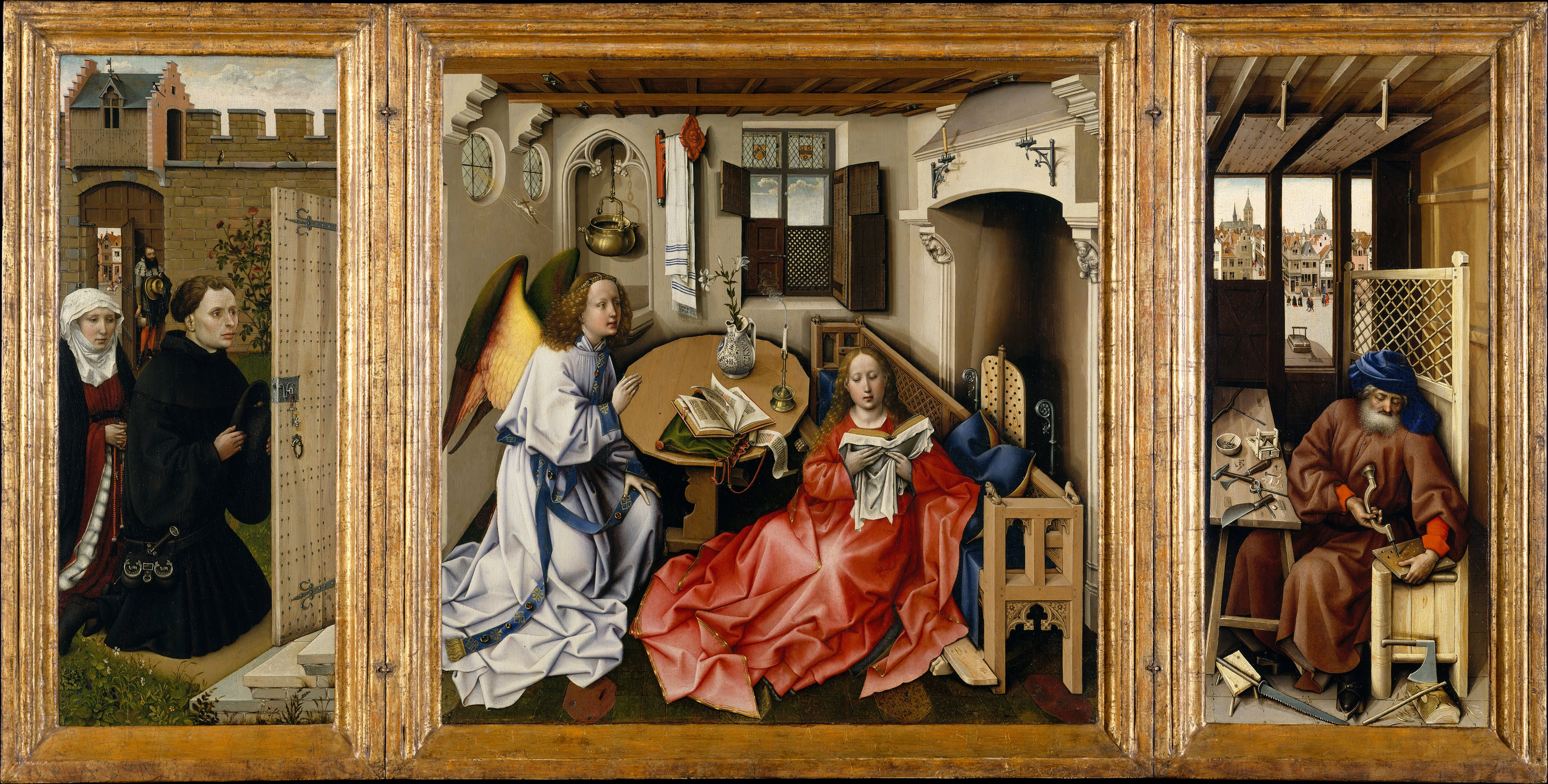
The painting on the left was done with oil paint in 1943 by Thomas Hart Benton, titled “July Hay.” The painting on the right was also done with the same medium in 1427 by Robert Champin, titled “Annunciation Triptych.” Both of these were done with the same medium so there are similarities, however there are also differences, such as the fact they are 516 years apart. Because the first painting is more recent, we can relate to it more because we have actually scene was is depicted with our own eyes. Older paintings like the second, are mainly focused on religion which is not actually witnessed by us, but we have a pretty broad idea of what they should look like.
When it comes down to similarities, we can automatically see these were both done as oil paintings. Both have amazing details and shadings of color. We are able to see depth in both paintings and even see folds and wrinkles in the clothing as they would be if these were photographs. These are both representational paintings. There are obvious divides of foreground, middleground, and background; the sky seems to be in the background of both pictures, leaving what is supposed to be focused on close to the viewer.
Contrasting the two paintings, they obviously are done with two completely different contexts. The first is realistic, representing the rural areas and harvesters of America in the 20th century. The details were put into mainly the nature within the painting rather than the people. I chose this painting because I loved the details put into the forms of nature. The tree in the foreground, along with the leaves and flowers are so beautiful and mesmerizing to me. I know this painting isn’t all the way realistic but I believe the painter chose to paint this environment purposely to show the beauty within it dramatically.
The second representational painting is more idealized. This painting is mainly focusing on Virgin Mary and Joseph. Nobody really knows how these people look, but they are still painted very well. Different from the first, this painting has its detailed focuses set on every person or little thing in the environment around them such as the buildings and the items on the wall. The context of this painting is representing the day Mary was told she would conceive a baby, Jesus. The painter had a wonderful imagination as you can tell because unlike the first painting, the painter was not actually a witness to this scenery. I chose this painting because I liked the division of the scenery. Not only can you pay attention to this by foreground, middleground, and background; you can look at this painting from right to left. It is as if you are there watching the order of operations to deliver the message commence. The division also allows you to see more than one place at once, that’s incredibly creative to me.
Monday, October 5, 2015
Blog Post #4

This is a painting called "The Three Graces" by William Etty. This painting is representational. The three daughters of Zeus have been illustrated naked in countless pieces of art. Just as most nude paintings, these women are shown in elegant poses, comfortable in the skin they are given. Since we truly don't know how any of these gods or goddesses looked, this work of art is idealized. This is not only an interpreted idea of what these specific girls looked like, but also the dream girl of an average man. In these times many naked women were depicted in the same manner; they were drawn or painted with curves, hips, descent sized breasts, beautiful hair. Most of these pieces weren't actually based on a real woman in front of the artist, but just what their idea of what a woman should look like. These women were idolized in a sense because of this idea of beauty within a woman. The Three Graces symbolized charm, beauty, nature, human creativity, and fertility. This idea of these women connects to what Berger stated in Ways Of Seeing, "She is not naked as she is. She is naked as the spectator sees her." The people of that time labeled these women as examples for all other females to follow, and then they were put into forms of how men wanted a woman to look.The irony of these women of beauty being painted in the same way the average woman was painted in every other nude painting in that century.
Monday, September 21, 2015
The spills.

Blog Post #2

My choice of artwork is called "Ecce Homo and Mater Dolorosa," by Pedro de Mena. This is from the Metropolitan Museum of Art. At first I was a bit confused, I wondered about the title of the art knowing that this is obviously a sculpture of Jesus and Mary. After some research I learned that this title is Latin for "Behold the man" and "Mother of sorrows." "Behold the man!" were the words stated when Jesus was being brutally presented with this crown of thorns. Mary, is birth mother of course was tortured by this image of her son being slowly killed in this manner, which gives her the title of "Mother of sorrows." This sculpture shows you the emotion of both the man and the mother whom were both clearly in distress. You can't help but feel sympathetic over the idea of the situation. This artwork is a 3d form with a medium of wood and paint. I believe the purpose of this was to commemorate the memory of Jesus and Virgin Mary and to construct a meaningful form of their existence. The choice of placement of this piece also illustrates value. This piece was placed in a dark corner while the piece itself is bright; it is even more bright because of where it is placed. There is a lot of texture within the clothing, it is so realistic you can see every wrinkle and every fold. Due to the context being an era of Christ, every bit of this piece is realistic as can be, almost too realistic in a sense. The realism is shown from the clothing, to the illustration of their face expressions, to the choice of what was used to torture Jesus. You get so much emotion from the small details like blood, tears, and scratches that these sculptures seem almost alive. My opinion of the purpose of this art work is exactly what the title expresses. To behold the man and his mother of sorrows is the purpose! To examine every bit of torture visually rather than reading about it as we are used to. Especially since this is 3d it is way more fascinating to see every inch of this man. We get to almost feel the pain in Mary's heart, to imagine how she felt seeing her son the way we are seeing him in this sculpture. And imagine even later when the torture was worse!
Monday, September 14, 2015
Post #1

This is an art piece by Kim Rosen. She is known for 2d illustrations. I'm sure most of you have seen this inside the trains almost every day. I always stare at this every time I see it. I stare at every single person and study all their features like how she chose to dress them and add certain accessories or hair styles. I also love how the variety of ages, nationalities, races, and cultures are illustrated. This was made specifically for our subways and the purpose of it I believe is to show an extraordinary version of ordinary objects. Or in this case, ordinary scenery. These are people we see every day around us in this lovely city of ours. We are able to meet all these various kinds of people on the subways but we don't always pay attention. I think this piece is to make you pay attention. It is to show you every person who might be around you but you might not have even noticed. The men from different countries who are trying to get to work to provide for their families, just like everyone else. The old woman or children patiently waiting for a seat. The man with a unique sense of style who decided to gauge is ears. Or even things as simple as the variety of hair styles we all choose. Like dreads or a crazy hair color. The colors we love to wear or the designs on our clothes. All this and much more is shown in this art piece. You just have to look; you have to pay attention. This is what is around you; and it is all crunched together in this long frame.
Intro -

Subscribe to:
Posts (Atom)